
Smart Cargo Redistribution (SCR)
Systems Designer & Strategist
Every year, thousands of tons of refrigerated cargo are discarded after cold-chain failures, even when much of the food is still recoverable.
Smart Cargo explores how existing logistics infrastructure could be orchestrated to transform these losses into humanitarian assets. This architecture shifts the industrial default from "loss disposal" to "asset recovery," creating a data-driven bridge between maritime shipping and global food security.
Context
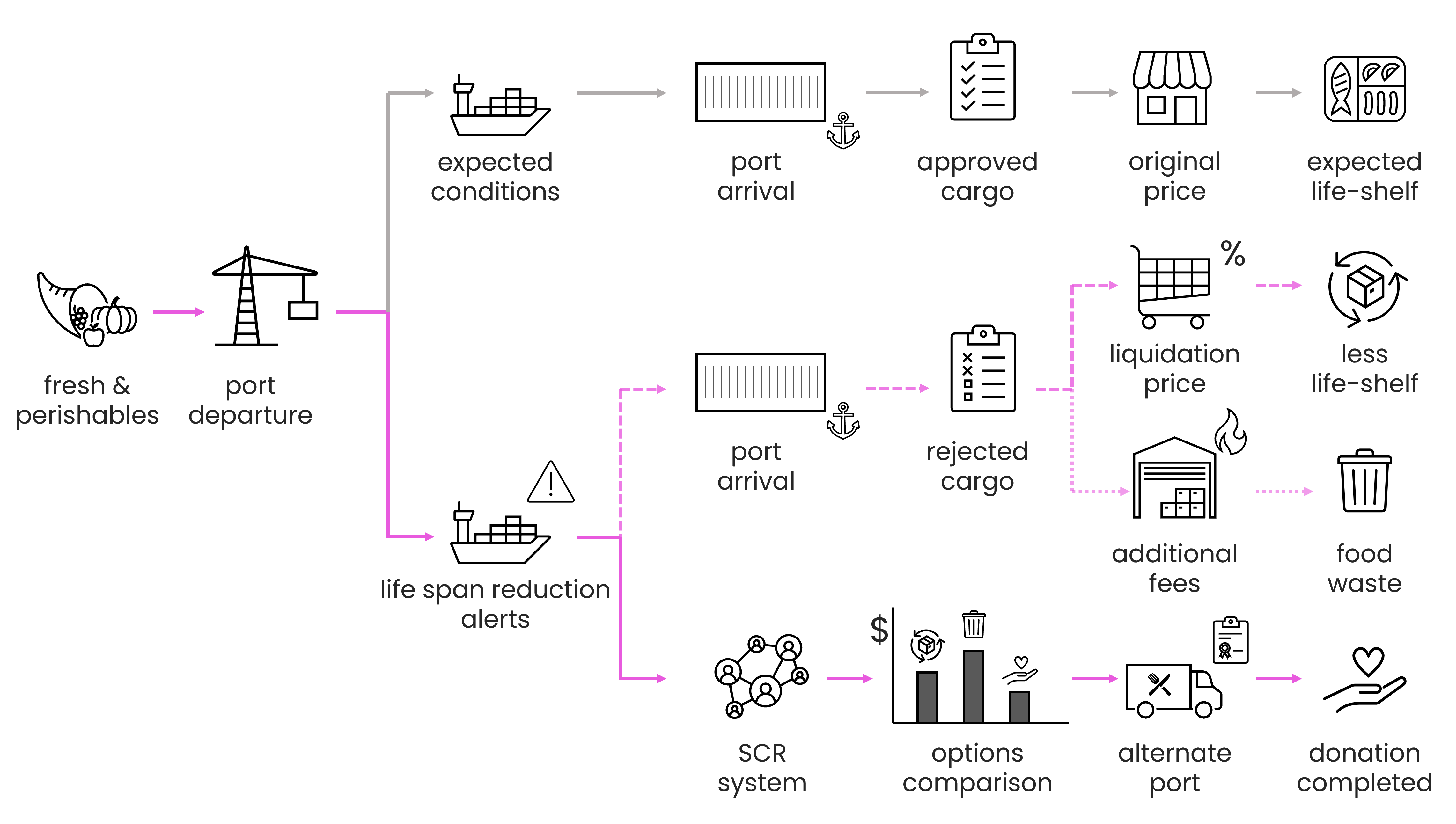
Global food loss in maritime logistics represents a critical paradox: while refrigerated containers transport the world’s most nutrient-dense perishables, they account for over 1.4 million tons of annual waste. Currently, when environmental sensors detect a breach in transit—such as fluctuations in temperature or atmospheric composition—cargo is often sold at liquidation prices or incinerated to avoid escalating costs from port storage (demurrage) and insurance complications. SCR explores the systemic gap between these monitoring alerts and the ultimate disposal of still-viable cargo.
Challenge
How might we transform logistical failures into social opportunities by making cargo rescue more economically viable than disposal?
The challenge was to conceptualize a decision-support framework that positions "rescue" as a superior alternative to incineration or low-value liquidation. In an industry where disposal is the "known cost" and salvage is perceived as a risk, the system is designed to:
- Incentivize Agency: Provide cost-effective alternatives that empower cargo owners to lead the decision-making process and engage with their social impact.
- Invert the Economic Incentive: Contrast the "Total Cost of Waste" (incineration and inventory loss) and "Liquidation Deficits" (logistics fees vs. low recovery prices) against the "Total Value of Rescue" (tax credits, social equity, and avoided disposal fees).
- Orchestrate a Secondary Life: Bridge the gap between rigid maritime protocols and the high-speed requirements of humanitarian food banks.
Proposed Framework
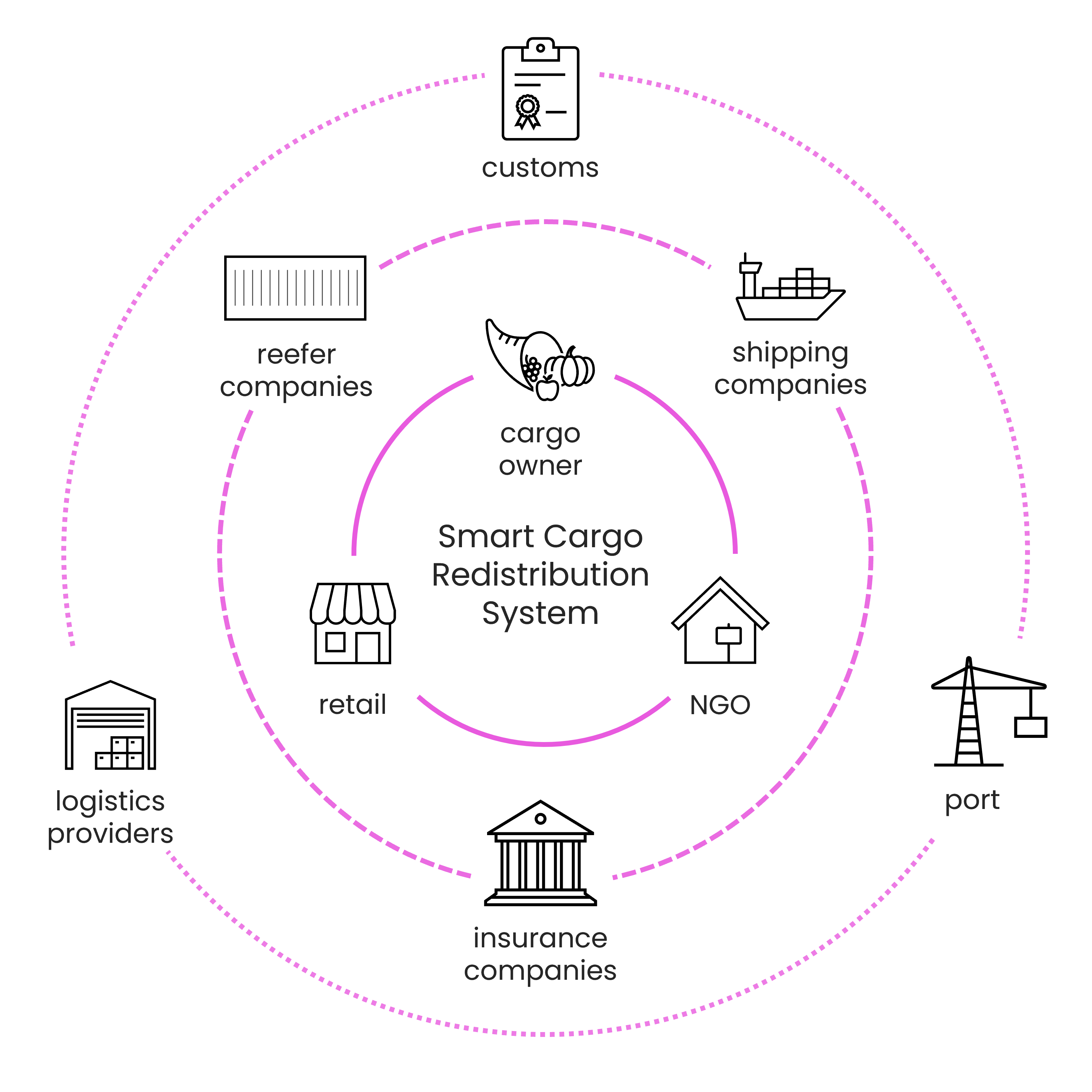
SCR acts as a strategic intelligence bridge between logistics providers and humanitarian action. The architecture includes:
- The Smart Alert System: Logic layer that consumes existing IoT monitoring data to flag shipments that are commercially "at-risk" but still nutritionally viable.
- The Top-3 Alternative Engine: Decision-support interface that generates three salvage scenarios (e.g., humanitarian donation, local secondary market, or emergency processing), presenting a comparative cost-benefit analysis for each.
- The Redistribution Logics: Data-driven workflow that orchestrates "cross-donated" services—such as waived port storage or tax-deductible handling—to execute redirection before cargo integrity is lost.
Key Learnings
- Incentive Alignment: Real sustainability in logistics occurs only when the "green path" is also the most cost-effective. Designing for rescue requires addressing the primary financial pressures of the cargo owner.
- Interoperability as a Solution: Innovation in this sector doesn't require new hardware; it requires a software and legal bridge that allows existing maritime data to trigger social action.
- Strategic Choice: Providing options rather than automated outcomes increases client accountability, turning a logistical failure into a CSR win.
- Resilience through Data: This project explored how large-scale data systems can be designed for social resilience. In complex ecosystems, interoperability is the most powerful tool to transform industrial inertia into tangible impact.
Notes
Neutral Complementary Layer: SCR is a hardware-and-software-agnostic "rescue
layer" that integrates with the existing maritime ecosystem without replacing current service providers.
Zero-Friction Integration: By acting as a specialized add-on, the framework
avoids the barriers of proprietary hardware, leveraging existing APIs to trigger humanitarian action.
Socio-environmental Impact: Designed as an innovation framework that balances
economic viability with environmental sustainability.